
Can Bunions Come Back After Surgery? Understanding Bunion Recurrence
One of the most common questions patients ask before bunion surgery is:
“Can my bunion come back after surgery?”
The short answer is yes, bunion recurrence is possible after surgery—but the risk can vary depending on the type of procedure performed, the severity of the deformity, and how completely the underlying mechanics of the bunion are corrected.
For patients considering bunion surgery in Southlake, Keller, Grapevine, Fort Worth, or elsewhere in North Texas, understanding why bunions develop in the first place can help explain why some surgical approaches may have different recurrence rates.
Why Do Bunions Come Back After Surgery?
A bunion is much more than the bump you see on the side of the big toe.
Hallux valgus is a complex, three-dimensional deformity involving displacement and rotation of the first metatarsal and great toe. An important component of many bunion deformities is instability and abnormal motion at the first tarsometatarsal joint, or first TMT joint, located farther back in the midfoot.
Think of the visible bunion as the end result of a problem occurring farther upstream.
If surgery focuses primarily on correcting the visible portion of the deformity without adequately addressing the mechanics contributing to it, there may be an opportunity for the deformity to gradually return.
This is one reason that choosing a bunion procedure should involve more than simply asking, “How are you going to remove the bump?”
A better question is:
“How is my surgery going to correct the underlying deformity?”
The First TMT Joint and Bunion Formation
The first metatarsal connects to the medial cuneiform at the first tarsometatarsal joint.
In many patients with hallux valgus, instability at this joint allows the first metatarsal to drift and rotate out of its normal position. As this occurs, the great toe moves in the opposite direction toward the lesser toes.
The result is the characteristic bunion deformity.
This also explains why simply shaving down the bump doesn't necessarily address the entire problem. Modern bunion surgery increasingly recognizes hallux valgus as a three-dimensional deformity rather than simply a bump on the side of the foot.
How Does Lapiplasty® Address Bunion Recurrence?
The Lapiplasty® 3D Bunion Correction® procedure is designed to correct the bunion in three dimensions while addressing the unstable first TMT joint.
Rather than simply removing the bump or cutting and shifting the metatarsal farther down the foot, the surgeon repositions the first metatarsal into improved three-dimensional alignment.
The first TMT joint is then prepared and fused in the corrected position.
In simplified terms, the procedure is designed to:
Correct the sideways displacement of the metatarsal
Correct abnormal rotation of the metatarsal
Restore more normal alignment of the great toe and sesamoids
Stabilize the first TMT joint
Maintain the correction with multiplanar fixation
Treace Medical Lapiplasty addresses the unstable midfoot joint associated with the bunion while correcting the deformity in all three planes.
What Is the Recurrence Rate After Lapiplasty?
Clinical research has demonstrated relatively low rates of radiographic recurrence following Lapiplasty.
Treace Medical has reported 0.9% to 3.2% recurrence rates in studies with approximately 13- to 17-month follow-up. One prospective study reported one recurrence among patients evaluated at 12 months, corresponding to a 0.9% recurrence rate.
Longer-term evidence is now available as well.
A multicenter prospective study published with four-year follow-up reported a recurrence rate of 0.8% when recurrence was defined as a postoperative hallux valgus angle greater than 20 degrees. When researchers used the more stringent definition of greater than 15 degrees, the radiographic recurrence rate was 8.4%.
That distinction is important because “recurrence” can be defined differently among studies. A small change visible on an X-ray does not necessarily mean that a patient has developed a painful or clinically significant bunion again.
Why the Definition of Recurrence Matters
When researching bunion surgery, patients may see dramatically different recurrence percentages online.
Part of the reason is that studies don't always define recurrence the same way.
Researchers may use measurements such as the hallux valgus angle (HVA) to determine whether a bunion has radiographically recurred. A study defining recurrence as HVA greater than 15 degrees will naturally report more cases than one using HVA greater than 20 degrees.
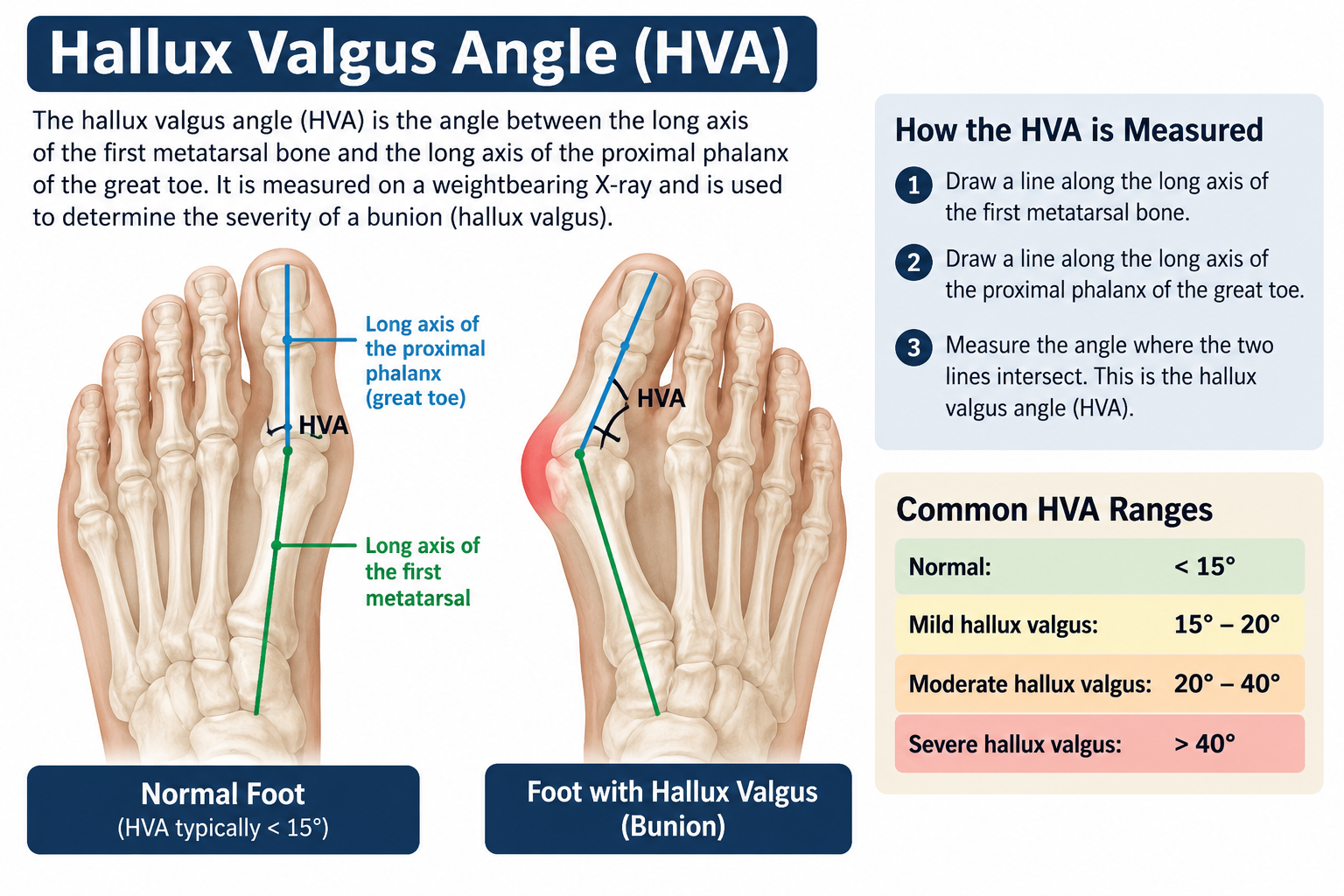
Radiographic recurrence also isn't necessarily the same thing as symptomatic recurrence.
A patient's X-ray can demonstrate some loss of correction while the patient remains pain-free, active, comfortable in shoes, and satisfied with the surgical result.
That is why recurrence statistics should always be interpreted alongside the study's definition and length of follow-up.
Can a Bunion Still Return After Lapiplasty?
Yes.
No bunion surgery can guarantee a zero-percent recurrence rate.
Even when the first TMT joint is addressed, several factors can potentially influence long-term alignment, including the severity and complexity of the original deformity, joint position, quality of the initial correction, bone healing, associated deformities, and individual anatomy.
Research into Lapiplasty also suggests that obtaining a complete initial three-dimensional correction—including appropriate sesamoid position—is important for maintaining correction over time.
The goal should therefore not simply be to choose a procedure with a particular name. The quality of the correction and the surgeon's understanding of three-dimensional bunion mechanics matter as well.
Not Every “Lapiplasty” Is Necessarily Lapiplasty®
Patients should also understand that Lapiplasty® is a specific procedure and system developed by Treace Medical Concepts.
The broader category of surgery involving fusion of the first TMT joint is commonly referred to as a Lapidus procedure. There are multiple techniques and implant systems that surgeons can use to perform a Lapidus-type correction.
If a surgeon recommends Lapiplasty, it is reasonable to ask:
“Are you performing the actual Lapiplasty procedure using the Treace Medical Lapiplasty system?”
Patients may also want to ask how frequently the surgeon performs that particular procedure and what their own experience has been with recurrence, healing, complications, and return to activity.
Choosing Bunion Surgery Based on the Cause, Not Just the Bump
Bunion surgery has changed considerably over the years.
The goal should not simply be to make the bump disappear. A comprehensive bunion evaluation considers the entire three-dimensional deformity, including the position and rotation of the first metatarsal, sesamoid alignment, the first TMT joint, the great toe joint, and any associated deformities.
For the appropriate patient, Lapiplasty 3D Bunion Correction is designed to address the deformity at the first TMT joint and stabilize that joint in its corrected position.
Published research summarized by Treace has reported recurrence rates around 1%–3% in earlier studies, while newer four-year data demonstrate that recurrence remains low when using the commonly cited HVA >20° definition.
Bunion Surgery in Southlake and North Texas
If you're considering bunion surgery in Southlake, Keller, Grapevine, Colleyville, Fort Worth, or the surrounding Dallas-Fort Worth area, don't be afraid to ask your surgeon about recurrence.
Ask what procedure is being recommended, why that procedure fits your particular deformity, whether the first TMT joint needs to be addressed, and how frequently your surgeon performs that operation.
Most importantly, make sure your surgeon can explain why your bunion developed, how the recommended surgery corrects the deformity, and what is being done to help maintain that correction long-term.
Bunion surgery shouldn't simply treat the bump you can see.
The goal is to understand—and appropriately address—the mechanics behind it.
Sources
Treace Medical Concepts. Lapiplasty® Journal Publications and Clinical Outcomes. Published clinical summaries include recurrence outcomes from multicenter studies of triplanar first tarsometatarsal arthrodesis.
Treace Medical Concepts. Lapiplasty® 3D Bunion Correction® Patient Milestone. Treace reports recurrence rates of 0.9%–3.2% in earlier clinical studies.
Hatch DJ, et al. Four-year outcomes following triplanar tarsometatarsal arthrodesis with early weightbearing for hallux valgus: A multicenter prospective study. Journal of Foot & Ankle Surgery. Four-year recurrence reported as 0.8% using HVA >20° and 8.4% using HVA >15°.
Individual results vary. The appropriate bunion procedure depends on each patient's anatomy, symptoms, activity goals, medical history, and examination.