
Do Bunion Correctors and Toe Spacers Actually Work? The 3D Bunion Doc discusses how they can help and not help your bunion(s)
Do Bunion Correctors and Toe Spacers Actually Work?
If you have a bunion, you have probably seen advertisements for bunion correctors, toe spacers, bunion splints, and silicone separators that promise to straighten your big toe. Some even show impressive before-and-after images suggesting that wearing a simple device can permanently correct a bunion.
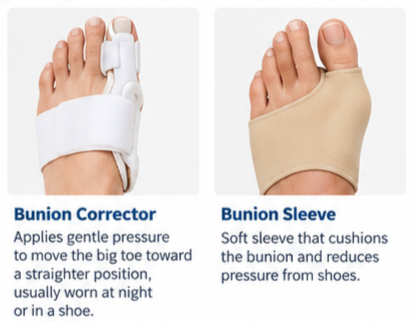
So, do bunion correctors and toe spacers actually work?
The answer is sometimes—but primarily for temporary alignment and temporary symptom relief.
Toe spacers and bunion correctors can reduce pressure, decrease rubbing between the toes, improve comfort, and temporarily move the big toe into a better position. However, they generally cannot permanently correct the structural deformity that causes a bunion.
Once the device is removed, the external force holding the toe straighter disappears, and the bunion typically returns to its previous position.
That doesn't mean these devices aren't useful. For the right patient, they can be an inexpensive way to manage bunion discomfort. Toe spacers may also be useful after bunion surgery to help maintain proper alignment while the foot heals.
What Causes a Bunion?
A bunion, medically known as hallux valgus, is more complicated than a bump on the side of the foot.
The bump develops because the bones of the foot have moved out of their normal alignment. The first metatarsal—the long bone directly behind the big toe—moves in one direction while the big toe begins drifting toward the second toe.
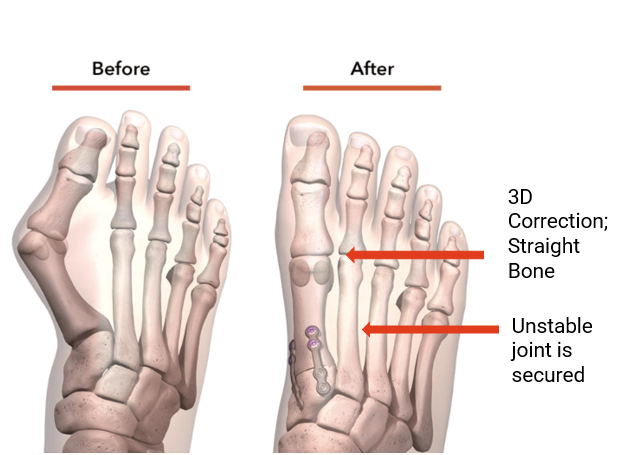
In many bunions, an important part of the deformity originates farther back in the foot at the first tarsometatarsal joint, or first TMT joint.
Instability and abnormal motion at this joint can allow the first metatarsal to move out of alignment. As this occurs, the bunion becomes increasingly visible at the big-toe joint.
This explains one of the biggest limitations of bunion correctors: a device pushing on the big toe does not permanently correct the underlying instability or position of the first metatarsal.
How Do Toe Spacers Help Bunions?
A toe spacer is typically placed between the big toe and second toe. It gently pushes the big toe away from the second toe and toward a straighter position.
This may help:
Reduce pressure between the big and second toes
Decrease rubbing and irritation
Temporarily improve toe alignment
Make certain shoes more comfortable
Reduce discomfort from overlapping or crowded toes
Relieve pain caused by pressure or misalignment
For some patients, this can make a substantial difference especially in shoes.
If a $10 or $20 toe spacer allows you to walk, exercise, or wear shoes more comfortably, then it is doing exactly what you need it to do.
The important thing is understanding the difference between relieving the symptoms of a bunion and permanently correcting a bunion.
Can Toe Spacers Permanently Fix a Bunion?
NO……
When you insert a toe spacer, an external force pushes the big toe toward a straighter position. You may even notice an immediate visual improvement.
Remove the spacer, however, and the deformity typically returns.
Why?
Because the spacer has not changed the underlying position of the bones and joints responsible for the bunion.
The same principle applies to most bunion splints and bunion correctors. A splint may use straps or a hinge to provide more leverage than a simple silicone spacer, but it is still applying an external force to the toe.
Temporary straightening is not the same as permanent correction.
Can Bunion Correctors Relieve Pain?
Absolutely.
Not everyone with a bunion needs surgery.
If a toe spacer or bunion corrector decreases your pain enough that you can comfortably perform your normal activities, it may be a very reasonable treatment.
Other conservative treatments may include wider shoes, appropriately shaped toe boxes, padding, activity modification, inserts, and custom orthotics.
Orthotics cannot make an established bunion disappear, but they may improve foot mechanics and redistribute pressure.
The goal of conservative bunion treatment isn't necessarily to make the foot look perfect. The goal is to keep you comfortable and active.
Can Toe Spacers Stop a Bunion From Getting Worse?
Patients frequently ask whether wearing a toe spacer every day can prevent bunion progression.
A spacer may maintain better big-toe alignment while you are wearing it, but it cannot guarantee that the bunion won't worsen.
If instability and abnormal mechanics are occurring farther back in the foot, the spacer does not eliminate those forces.
For that reason, I generally consider toe spacers and bunion correctors symptom-management tools rather than permanent methods of correcting or preventing a bunion.
When Is Bunion Surgery Appropriate?
Simply having a bunion does not mean you need surgery.
Surgery becomes a consideration when the bunion is painful, interferes with comfortable shoe wear, or prevents you from participating in activities you want to do.
For example, you may consider bunion surgery when pain is preventing you from comfortably:
Walking or standing
Exercising or running
Working
Hiking or playing sports
Wearing reasonable shoes
Participating in your normal daily activities
The decision should be based on pain and function—not simply appearance.
How Does Bunion Surgery Address the Root Cause?
This is where surgery is fundamentally different from a bunion corrector.
A toe spacer applies an external force to temporarily move the big toe.
Bunion surgery is designed to change the structural alignment of the foot itself.
Depending on the patient's deformity, surgery may reposition the first metatarsal, correct abnormal rotation, realign the big toe, and stabilize the portion of the foot contributing to the bunion.
For bunions associated with instability at the first TMT joint, procedures such as Lapiplasty® 3D Bunion Correction can address the deformity at that level.
Rather than simply shaving off the visible bump, the goal is to correct the metatarsal's position in three dimensions and stabilize the unstable joint.
Once the corrected bones have healed, the correction is maintained by the reconstructed anatomy rather than an external device pushing against the toe.
No bunion procedure can guarantee that recurrence will never occur, and the appropriate procedure depends on each patient's anatomy. However, surgery provides an opportunity to address the underlying structural cause rather than simply temporarily repositioning the toe.
Why Use a Toe Spacer After Bunion Surgery?
Interestingly, toe spacers can be particularly helpful after bunion surgery.
After surgery, the bones have been corrected, but the surrounding muscles, tendons, ligaments, joint capsule, and other soft tissues still need time to heal and adapt to the corrected position.
A surgeon may therefore recommend a toe spacer to help maintain proper big-toe alignment during healing.
The difference is important:
Before surgery, the spacer is trying to temporarily reposition an existing structural deformity.
After surgery, the structural deformity has already been corrected, and the spacer is helping support that correction while healing occurs.
Patients should always follow their surgeon's specific postoperative instructions regarding whether and when to use a toe spacer.
The Bottom Line: Do Bunion Correctors Work?
Yes—but know what you're asking them to do.
Bunion correctors and toe spacers can be very useful for reducing pressure, decreasing rubbing, relieving pain, and temporarily improving big-toe alignment.
What they generally cannot do is permanently correct the underlying structural deformity. When the device is removed, the bunion typically returns to its previous position.
For patients whose bunions become painful enough to limit shoes, exercise, work, or everyday activities, surgery offers something fundamentally different: the ability to correct and stabilize the structural problem responsible for the deformity.
At Active Life Foot and Ankle of Texas in Southlake, Texas, our goal is to find the treatment that allows you to remain active and comfortable—whether that's better shoes, orthotics, a simple toe spacer, or surgical bunion correction.
Active Life Foot and Ankle of Texas | Southlake, TX
Where Your Active Life Begins Again.
This information is intended for educational purposes and does not replace individualized medical evaluation or advice.